
What Went Wrong? Understanding the Pattern of Sin from Genesis 3
What Went Wrong? Understanding the Pattern of Sin from Genesis 3
Have you ever found yourself in a situation where you asked, "How did I get here?" Maybe it was after making a poor decision, finding yourself somewhere you didn't want to be, or waking up with regret about choices you made. These moments don't usually happen instantaneously - they follow a pattern, and that pattern is revealed in one of the most famous stories in the Bible.
The Serpent's Introduction: More Than Just a Snake
Genesis 3:1 introduces us to "the serpent" who was "more crafty than any of the wild animals the Lord God had made." While Genesis doesn't give us extensive details about this serpent's identity, later Scripture reveals this to be Satan himself - described in Revelation as "that ancient serpent called the devil or Satan, who leads the whole world astray."
Jesus describes Satan as "a liar and the father of lies" who "was a murderer from the beginning." This wasn't just an ordinary talking animal, but a supernatural being engaged in spiritual warfare. Every time we face temptation, something spiritual is happening beyond what we can see.
The Four-Step Cycle of Sin
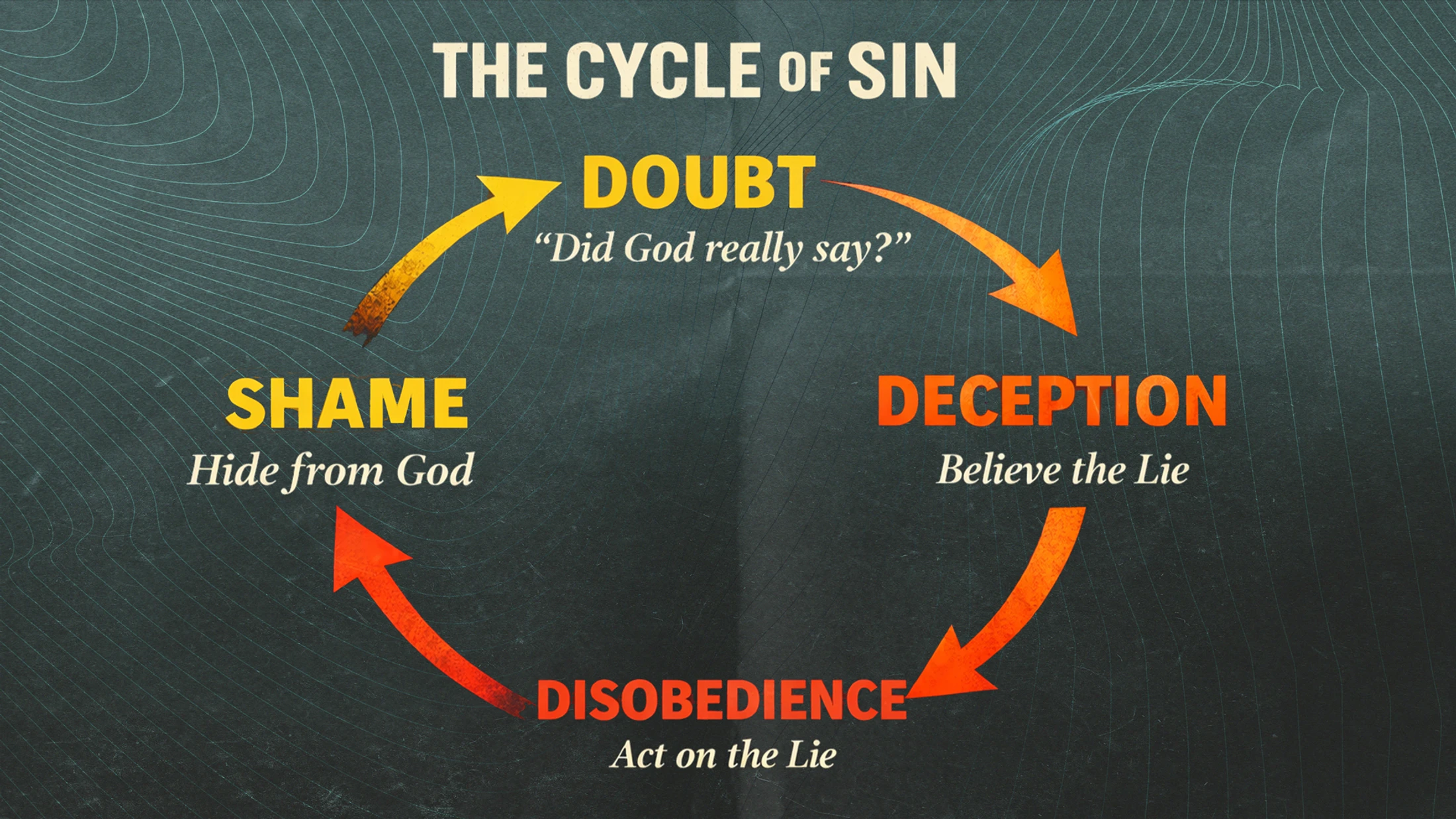
The story of Adam and Eve's fall reveals a pattern that plays out in our lives regularly: doubt, deception, disobedience, and shame.
Step 1: Doubt - "Did God Really Say?"
Satan's opening strategy begins with a simple question: "Did God really say, 'You must not eat from any tree in the garden?'" This question plants a seed of doubt about God's word and, more importantly, about God's goodness.
Notice the deception in Satan's question. God had given Adam and Eve access to every tree in the garden except one. They had 99.9999% of everything available to them, yet Satan frames it as if God was withholding everything good from them.
This same tactic works today. Satan rarely tells us to directly disobey God. Instead, he asks questions that make us doubt God's goodness:
- "Did God really say you can't be happy?"
- "Did God really say you have to put up with this situation?"
- "Doesn't God want what's best for you?"
Step 2: Deception - Believing the Lie
Once doubt takes root, deception follows. Eve saw that the fruit was "good for food and pleasing to the eyes and also desirable for gaining wisdom." Notice these weren't inherently evil things - they were good things that God had already provided in other ways.
Satan uses good things to deceive us. He tempted Jesus with legitimate needs: food when hungry, recognition, and power. The deception lies in believing we need something we don't currently have to be truly satisfied or happy.
The Hebrew word used here for "desirable" is often translated as "covet" elsewhere in Scripture. It represents the attitude that says, "I need something I don't now have in order to be happy."
Step 3: Disobedience - Acting on the Lie
Deception leads to action. Eve "took some and ate it. She also gave some to her husband, who was with her, and he ate it."
It's important to note that Adam was present during this entire exchange. He wasn't deceived like Eve was - he made a conscious choice. This represents the first moment we see someone abdicating their God-given responsibilities, passively watching sin unfold rather than taking action to prevent it.
Step 4: Shame - Hiding from God
Immediately after their disobedience, "the eyes of both of them were opened, and they realized they were naked. So they sewed fig leaves together and made coverings for themselves."
Before sin, they were "naked and felt no shame." Now, the same condition that once represented perfect intimacy and vulnerability became a source of shame and hiding. When God came walking in the garden as He regularly did, they hid among the trees.
Shame tells us we are nothing better than our worst moments. It makes us want to hide from God and from others, believing we're too far gone for redemption.
This Is Our Story Too
This isn't just Adam and Eve's story - it's ours. We follow this same pattern regularly. We doubt God's goodness, believe lies about what we need to be happy, act on those lies, and then hide in shame from the consequences.
When asked "What's wrong with the world?" author G.K. Chesterton replied, "Dear sir, I am." This honest assessment recognizes that the problem isn't just "out there" - it's in each of us.
The Reaching Down
But the story doesn't end with the fall. When someone falls, their natural reaction is to reach up for help. From the moment Adam and Eve fell, they were reaching up, and Jesus was reaching down.
Throughout Scripture, we see God's persistent love for His fallen creation. He didn't abandon Adam and Eve in the garden, He didn't abandon Israel in the wilderness, and He doesn't abandon us today.
Jesus came as Emmanuel - "God with us" - to defeat that ancient serpent and restore what was lost. As 1 Corinthians 15:22 says, "For as in Adam all die, so in Christ all will be made alive."
Breaking the Cycle
The key to breaking this sin cycle is addressing it at the first step: doubt. When we truly know God's word - not just in our heads but in our hearts - and understand the goodness behind His commands, we can stop the cycle before it gains momentum.
The enemy's whisper often comes as "Did God really say?" or "Doesn't God want you to be happy?" Recognizing these questions for what they are - attacks on God's character and goodness - helps us stand firm in truth.
Life Application
This week, examine where the enemy might be trying to get you to doubt God's word. What area of your life is he whispering, "Did God really say?" or "Doesn't God want you to be happy?"
Identify where you might currently be in the sin cycle. Are you wrestling with doubt about God's goodness? Are you believing lies about what you need to be fulfilled? Have you acted on those lies? Are you hiding in shame?
Remember that no matter where you are in this cycle, Jesus is reaching down to pull you up. The story of Scripture is the story of a God who never stops moving toward His people.
Questions for Reflection:
- Where is the enemy currently trying to get you to doubt God's word or goodness?
- What lies are you tempted to believe about what you need to be truly happy?
- How can you better ground yourself in God's truth to break the sin cycle at its first step?
- If you're currently hiding in shame, how can you reach up to accept Jesus' outstretched hand?